


Introducing the Amethyst Pentacle
A practical tool for developing and manifesting personal identity

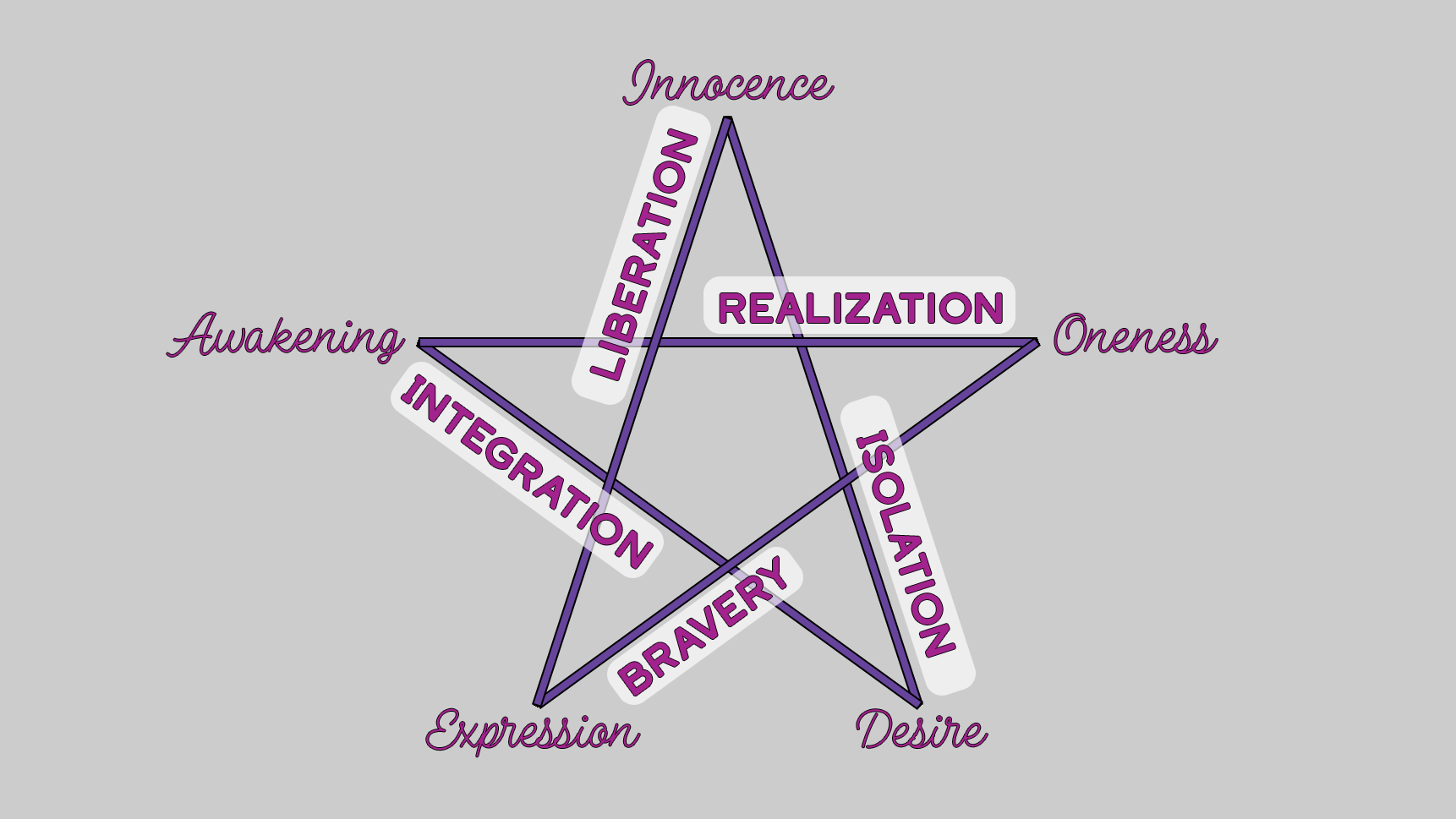
Human identity comprises far more than genetics, as conservative rhetoric would have us believe. Instead, identity is a complex of the physical, cognitive, and behavioral, expressed to the limits of safety within the social environment.
But a model of identity must be more than poetic. We need a practical model to explain how each of us finds our personal expression. To date, I left implementation as an exercise to the reader: an omission I intend to correct with a series of articles exploring a tool I discovered recently through Storm Faerywolf's book The Satyr's Kiss.
When I interviewed Storm in 2025, we discussed gender and sexuality as it pertains to magic and our existence within the Universe. Storm casually mentioned a model of gay coming-of-age and wondered what I might think of it.
That model is named The Amethyst Pentacle.
I admit, when I experienced the model for the very first time, I truly connected to it - and not just because it has the word "Amethyst" in it! The beauty of the Amethyst Pentacle is that it describes more than a gay coming-of-age story. It breaks down each step in the cycle of discovering and manifesting identity over the course of a human life.
Over the next series of six (or so) articles, I intend to consider all aspects of The Amethyst Pentacle to provide practical advice for manifesting who you are, here and now, in the world today.
And it all begins with a kiss from a satyr.
The Satyr's Kiss
Because I learned about the Amethyst Pentacle from Storm's book The Satyr's Kiss, the book deserves a short introduction of its own. Although Storm directs the book at gay men claiming (or reclaiming) their specifically Queer spirituality, I believe the book far surpasses that modest goal.
The Satyr's Kiss focuses on how social stigmas of being Queer affect the way each of us moves through the Universe. A truly Queer spirituality must recognize norms of gender, gender identity, and sexuality, then break them apart to reconstitute them - solve et coagula - as alchemical spirit.
Storm's intent was to speak only to gay men, yet I found much of my story as a transgender woman in Storm's. The Queer experience - the marginalization we face from a distinctly cisgender / heterosexual-normative world - runs deeper than one sector of our community. All of us must come to terms with who we are. All of us might need to defend ourselves for who we are.
But how do we understand the process when our world has so few examples of Queer identity with which to engage? Storm's book is an excellent resource, and we could use as many as we can find.
Aligning with All Identities
To explain a distinctly Queer experience of gay coming-of-age, Chas Bogan and Storm Faerywolf devised The Amethyst Pentacle in an article for the now-defunct zine "Witch's Eye: A Zine of Feri Uprising." Thankfully, the article now lives on Storm's personal website.
When I considered the process of recognizing social norms and deciding how we align with them, I realized this is not solely a gay man's task. It's not solely a Queer person's task.
This process is a common human experience. It is to define identity, and no one escapes it. The only difference any of us faces is whether we dive deep into who we are and create a beautiful expression of what we find...or accept someone else's version of who they want us to be.
Because this process is not specific to Queer identity, I took Storm's original Amethyst Pentacle as it applied to gay men and changed a few words to make it feel more encompassing. I generalized it slightly to fit within my own model of identity and gender.
To be clear, I do not claim Storm's model of the Amethyst Pentacle is bad or wrong - far from it. I've simply customized it to represent my work more fully. Maybe it's worth naming this custom version the "Amethyst(a) Pentacle?"
What Is a Pentacle?
Before we examine the Amethyst Pentacle itself, we must answer a simpler question: what does the name mean? What is a Pentacle, and why is it Amethyst?
A pentacle is sometimes described only as a pentagram - that is, a five-pointed figure like a star. Some traditions describe a pentacle as the five-pointed star contained within a circle, especially when worn as adornment such as a tattoo or jewelry.
Looking deeper, however, we find pentacles represent more than geometry. They represent mystical - even magical - tools for grounding concepts of power and action in reality.
A pentacle can be used as a talisman to protect or heal its wearer. A pentacle can be used as a repository of symbols and names that fuel magical workings. A pentacle can provide a point of focus for contemplation and meditation.
One such tool for contemplation from the Feri Witchcraft Tradition is the Iron Pentacle, from which the Amethyst Pentacle is patterned directly.
Queering the Iron Pentacle
The Iron Pentacle is an important realization of a practitioner's humanity within the Feri Witchcraft Tradition. But where the Iron Pentacle enumerates human qualities of sex, self, passion, pride and power, the Amethyst Pentacle steps back to consider the role of marginalization in the human experience.
Although every human is capable of experiencing sex, some sexual experiences are taboo to religion. Although every human could embrace self, some human expressions are diminished by society.
Although every human might be passionate, some passions simply burn too brightly for comfort. Although every human has reason to be proud, many would prefer to abolish Pride.
And power? Many of us will never come close to freedom within the White patriarchy of Western society.
Some may express themselves fully in this world. "But those who shine with violet souls in the world of men are forced to hide amongst the shadows," as Chas and Storm write. From the grand, yet largely unattainable, experience of the cisgender, heterosexual, White man in a patriarchy flows the more realistic experience of marginalized humanity in the Amethyst Pentacle.
In this universal tool, we find not just a universal process of discovery and personal magnification. We find recognition that none of us is above another in the Universe as we engage with the process of discovery.
The Points and Paths Forward
As we understand why the Amethyst Pentacle sprang from the need for inclusivity within Western spirituality, we can look forward to how it may be used in our personal work.
The image leading this article is the full and complete Amethyst Pentacle as I draw it. As a shape on the screen, it consists of a single, never-ending cycle. But the unbroken cycle also encompasses five distinct paths punctuated with five abrupt stops along the way.
Each of the points in the Amethyst Pentacle corresponds to a state of human experience we encounter in all aspects of life. Each of the paths in the Amethyst Pentacle is a process we must work to progress from one state to another.
Finally, each of the paths in the Amethyst Pentacle intersects two others. Just as we find human identity is described by individual intersectionality, so we find the process to develop identity requires constant intersection with our past.
The cycle is not one we complete once and never revisit. We experience this cycle for every characteristic we consider and develop about ourselves. And that cycle begins and ends and begins again our entire lives.
Beginning with the next article in this series, we will explore each of the points and paths in sequence. From beginning to end, each state is changed to another, intersecting our previous work.
We begin with a state of Innocence, and the painful process of losing it forever.
The views and opinions expressed are those of the authors and do not necessarily reflect the offical policy or position of The Purplepaw Clan, LLC. Please view the Disclaimer page for further information.